The Ultimate Guide to Creating a Successful Employee Recognition Program for Healthcare
In healthcare, employee turnover is not only an HR cost — it is a patient-care and financial risk. Staff RN turnover climbed back to a national average of 17.6% in 2025, and replacing a single bedside nurse now costs about $60,090, leaving the average hospital losing roughly $5.19 million a year to RN churn; each percentage point of turnover costs or saves the average hospital around $295,000 (NSI, 2026). Behind those numbers is a morale problem — nurse job satisfaction has fallen to 47%, and nearly a quarter of nurses say they may leave the profession within a year (Nurse.org, 2026). These headline figures are RN-specific; physicians, allied health, and the non-clinical workforce face different drivers and turnover economics, so treat the nursing data as illustrative of the stakes rather than a universal number.
An employee recognition program is one of the most direct, lowest-cost levers on that problem — but it is only one lever, and an important caveat comes first: recognition cannot substitute for safe staffing, manageable workloads, and competitive pay. Recognizing exhausted, short-staffed clinicians without addressing the conditions driving them out reads as tone-deaf and can backfire. Used honestly, alongside real improvements to workload and pay, recognition reinforces the meaning and teamwork that keep clinicians in the profession.
This guide outlines 13 healthcare-specific steps to build a program that supports retention, culture, and ultimately patient care.


Get Executive and Board Buy-In
Make the case in the language healthcare leadership and boards already use: patient safety, quality scores, and margin.The financial argument is unusually concrete — at ~$60,090 per RN departure and ~$295,000 per point of turnover, even a small retention improvement returns real money (NSI, 2026) — and if anything that vendor figure is conservative next to independent academic estimates that, adjusted for inflation, run higher still (Jones, 2008).
The quality argument is just as strong: continuity of care depends on retaining experienced staff, and patient-experience (HCAHPS) scores feed CMS’s Value-Based Purchasing program, which ties a portion of Medicare reimbursement to them. Framing recognition as a contributor to retention, safety, and reimbursement — not a perk — is what earns executive and board support.
Appoint a Program Manager Who Understands Clinical Realities
Give the program a clear owner who understands how a hospital actually runs: 24/7 shifts, distinct units, and a workforce that spans nurses, physicians, allied health, and the essential non-clinical staff who keep the building running. The healthcare-specific challenge is reach — a program that only touches day-shift, on-site staff will miss the night-shift, weekend, float-pool, and remote workers who most need to feel seen. The owner needs the authority and the tools to reach every shift and unit.
Choose a Program Type Built for Shift Work and Clinical Teams
Align the program to the outcomes you need — lower first-year and specialty-unit turnover, stronger engagement, better teamwork across disciplines. Design around healthcare’s realities: around-the-clock shifts, high-intensity specialty units (step-down, telemetry, and emergency turn over fastest), and a clinical/non-clinical divide.
Peer-to-peer recognition is especially powerful in clinical teams, where respect from colleagues who understand the work carries more weight than top-down praise. Build for the whole care team, not just the roles that are easiest to see.
Define a Realistic Budget
A common benchmark is roughly 1% of payroll for recognition and rewards (WorldatWork, 2024) — calibrate it to your organization and goals rather than treating it as a rule. The return case in healthcare is exceptionally strong because turnover is so expensive: against ~$60,090 per RN and millions per hospital annually, even a modest reduction in regretted attrition recovers the program cost many times over (NSI, 2026).
Recognition is a cost-effective complement to the pay and staffing investments that must come first — not a cheaper alternative to them. Set the budget against a specific retention or engagement target and measure against it (see step 13).

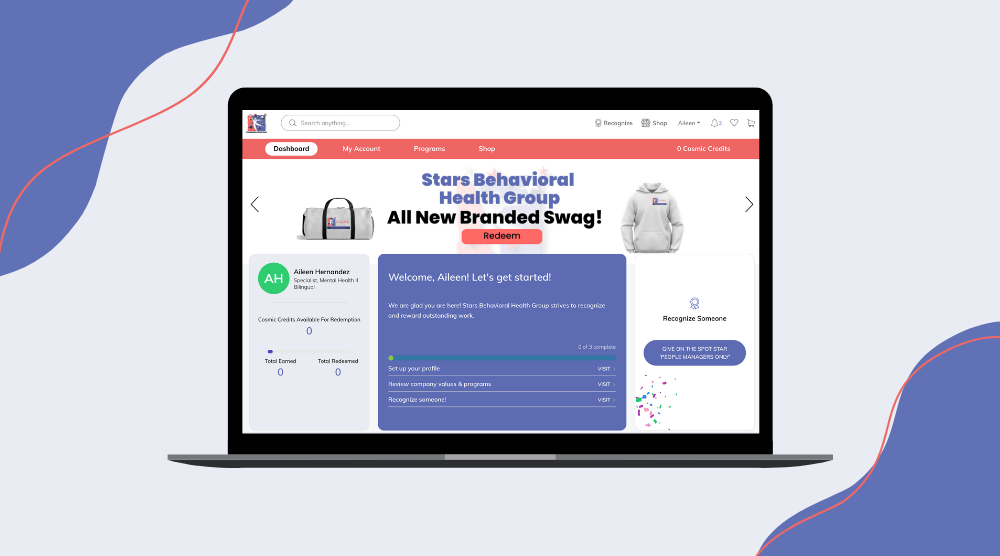
Implement Recognition Software That Reaches Every Shift
The right platform makes recognition consistent across shifts, units, and sites rather than dependent on which manager is a natural encourager. For healthcare, the decisive requirement is reaching a deskless, around-the-clock workforce: many frontline and night-shift nurses don’t have or check a company email, so mobile-first, SMS-style access dramatically outperforms email-based tools — frontline nursing response to email surveys often runs 18–22%, versus 65–72% for mobile-first channels (People Element, 2026).
Choose software that works on a phone, across shifts, and integrates without adding to clinical workload.
Set Clear, Patient- and Retention-Linked Goals
Define SMART goals — specific, measurable, achievable, relevant, time-bound. The most powerful healthcare goals connect recognition to what leadership tracks: reduce first-year nurse turnover (where much attrition concentrates), improve retention in the fastest-churning specialty units, lift engagement and HCAHPS patient-experience scores, and strengthen interdisciplinary teamwork.
Communicate responsibilities clearly across units and shifts, and give each team a target worth striving for.
Align Recognition With Mission and Clinical Values
Healthcare workers are among the most mission-driven of any workforce — most entered the field to care for people. Recognition that connects to that calling, celebrating compassionate care, clinical excellence, and teamwork under pressure, resonates far more than generic praise. One caution: it has to be genuine. Clinicians are quick to spot performative recognition, and ‘pizza-party’ gestures offered in place of real support breed cynicism and can undercut the intrinsic motivation that sustains caregivers (Deci & Ryan, 2000). Tie recognition to real patient impact and to colleagues’ lived experience of the work.
Establish Clear Recognition Policies and Procedures
Define what qualifies as recognition-worthy, who can recognize whom, and when and how it happens. In healthcare, deliberately extend recognition beyond the visible bedside roles to the staff whose work is invisible when it goes right: environmental services, dietary, transport, techs, and the operational teams that keep care safe. Avoid tying recognition to metrics that could pressure clinical judgment or discourage honest reporting of safety events — recognition should reinforce a just, speak-up safety culture, not compete with it; patient-satisfaction scores in particular should never become a recognition target in ways that could nudge clinicians toward over-prescribing or over-testing to please patients.
In unionized settings — common in hospital nursing — design the program with awareness of collective-bargaining agreements, and make clear that recognition complements, and never substitutes for, negotiated pay and staffing commitments. Make peer recognition easy, and remember that a specific, timely acknowledgment often matters more than a formal award.

Offer Rewards That Fit a Clinical Workforce
Provide a relevant, appealing range of rewards from reputable vendors who deliver reliably. For an exhausted clinical workforce, the rewards that resonate most are often about time and wellbeing — extra PTO, wellbeing and mental-health support, flexibility — alongside development, certifications, and choice-based options.
Let employees pick what’s meaningful rather than assigning a one-size-fits-all gift. Rewards that acknowledge the physical and emotional toll of the work, and that support recovery and growth, land better than generic merchandise.
Create an Engaging, Inclusive Recognition Experience
Increase adoption by making recognition social, peer-driven, and visible across the organization — while being deliberate about including the shifts and units that usually miss out. Celebrate wins where the whole team can see them, and make sure night-shift, weekend, and float-pool staff are as visible as day-shift teams.
Employees who are recognized regularly feel a stronger sense of belonging, and in healthcare that visible, cross-shift recognition helps counter the isolation of high-intensity, around-the-clock work. Use gamification thoughtfully and never in ways that could incentivize unsafe shortcuts.
Promote Fairness Across Shifts, Units, and Roles
Ensure equal recognition opportunity so no one is overlooked because of their shift, unit, or role. This is a pronounced risk in healthcare: day-shift, on-site, and bedside staff are simply more visible than night-shift, float-pool, remote, and non-clinical workers — and those overlooked groups are often exactly where turnover and disengagement concentrate. Train managers on this bias, set recognition expectations that span all shifts, and track recognition distribution across shifts, units, and roles so fairness is a managed outcome, not an assumption (see step 13).
Improve Internal Communication
A well-functioning program depends on clear communication across a 24/7, multi-site, multidisciplinary workforce — one of the hardest communication environments anywhere. Partner with internal communications to reach every shift through the channels clinicians actually use (mobile, not just email or break-room posters), and make recognition visible so staff see it happening and know how to participate.
Be especially deliberate during periods of strain; transparent communication is itself a retention factor when clinicians are stretched.

Measure and Improve the Program’s Impact
Measurement is what makes recognition a strategic program rather than a morale gesture. Track the metrics leadership owns: turnover by unit, role, and tenure (especially first-year and fast-churning specialty units), recognition participation and distribution (to catch the fairness gaps in step 11), engagement and burnout indicators, and patient-experience and safety measures. Use listening tools that actually reach shift workers — mobile pulse surveys rather than email — so your data reflects the frontline, not just the one-in-five who answer email surveys (People Element, 2026).
The employee-experience-to-patient-experience link is well documented across service industries (Heskett et al., 1994; Gallup & Workhuman, 2023), though it is one contributor among many — staffing and workload matter at least as much — so treat your own measured results as the real test. Measure, diagnose root causes, and refine.
Strengthen Retention Across Your Healthcare Workforce
Healthcare teams carry the responsibility of caring for patients around the clock. Build a recognition strategy that reaches every shift, celebrates the people behind exceptional care, and strengthens the engagement and retention your organization depends on.