Recognitions

A Volatile Market and Leaner Teams
The biopharma market has undergone significant restructuring between 2024 and 2026, leaving many organizations with leaner teams and increased pressure on the employees who remain. Heavier workloads and fewer opportunities for advancement have created conditions that often lead to burnout.
According to Niche (2026), the industry experienced more than 14,000 layoffs in 2024 alone. Workforce instability has continued, with the share of biopharma employees who changed jobs involuntarily increasing from approximately 15% in 2024 to 27% in 2025 (Pharmaceutical Technology, 2026).

Rising Burnout and Declining Commitment
As organizations ask leaner teams to sustain growth, leaders face increasing pressure to balance workloads while keeping employees engaged and committed.
BCG (2026) notes that managing workloads and reinforcing engagement are critical to preventing burnout and reducing attrition. At the same time, employee commitment is declining. According to Pharmaceutical Technology (2026), the share of biopharma employees who expect to stay in their current role dropped significantly year over year, while the number considering leaving the industry altogether continues to grow.
The challenge extends across the sector. Pharmaceutical Executive (2026) identifies recruiting and retaining talent as the single biggest challenge facing the pharmaceutical industry today.

A Measurable Recognition Gap
Employee recognition remains a clear opportunity for improvement within the pharmaceutical industry. While organizations continue investing in retention strategies, engagement data shows recognition is one of the weakest areas of the employee experience.
According to Culture Amp's January 2026 Pharmaceuticals Benchmark, based on approximately 65 organizationsand 1.3 million survey responses, the industry ranks in the bottom half of all sectors for employee engagement and the bottom quartile for median eNPS. Feedback & Recognition was also identified as one of the lowest-scoring categories.
That gap represents an opportunity. A consistent recognition program can help strengthen engagement and complement broader efforts to improve retention, culture, and employee commitment.

How Rewardian Helps Pharmaceutical Teams

Recognizing innovation and impact
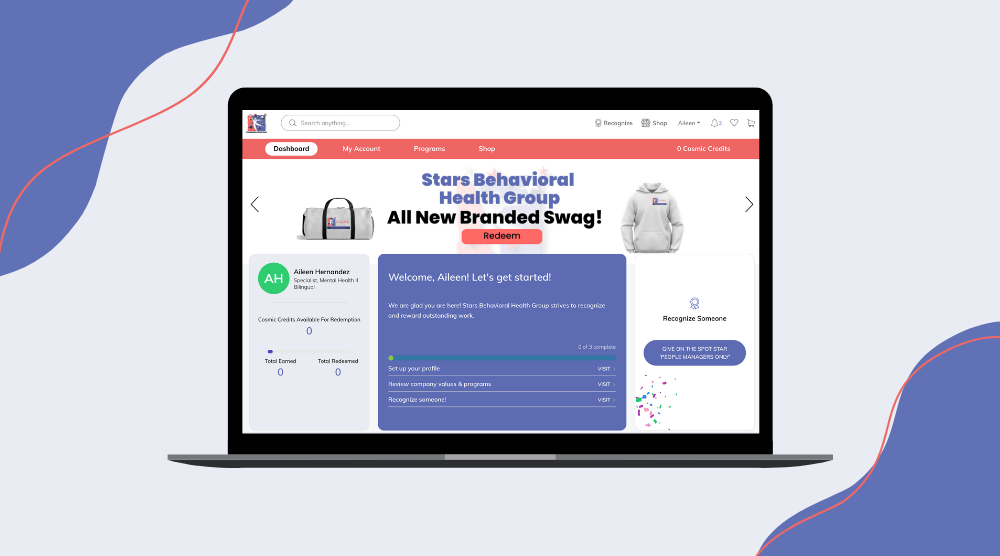
Rewardian helps pharmaceutical companies build recognition programs that celebrate the work that matters — contributions to drug development, regulatory milestones, clinical trials, and patient care — supporting engagement and a culture of excellence across R&D, manufacturing, and commercial teams.

Compliant, behavior-based incentives for commercial teams
Beyond recognition, Rewardian’s incentive engine supports configurable, behavior-based rules — tiered and velocity-based logic tied to the behaviors you want to reward — that can be designed to operate within your compliance framework. It’s the same capability behind Rewardian’s pharmaceutical sales-team guidance.

Rewards that motivate pharma professionals
Rewardian’s catalog spans 500K+ rewards and 10M+ options — merchandise, gift cards, and no-minimum branded swag — with travel, experiences (Switchfly), and concierge available on higher program tiers, so employees can choose rewards that feel meaningful in a high-pressure field.

Analytics and secure infrastructure
Rewardian’s real-time analytics and custom KPI dashboards surface engagement and recognition trends so leadership can act early. Rewardian is SOC 2 Type II certified, PCI certified, and GDPR compliant, with single sign-on (SSO) and secure multi-tenant infrastructure.
Proof & Resources
Rewardian works with life-sciences organizations — including Kindeva, a drug-delivery manufacturer running its program on Rewardian for roughly a thousand employees. Explore Rewardian’s pharma-focused guidance, including:
Read More
Pharmaceutical Guide The Ultimate Guide to Creating a Successful Employee Recognition Program for Pharmaceutical CompaniesRead More
Read More
Pharmaceutical Guide The Ultimate Guide to Creating a Successful Sales Incentives Program for Pharmaceutical CompaniesRead More
Read More
Pharmaceutical Guide The Ultimate Guide to Creating a Successful Channel Incentives Program for Pharmaceutical CompaniesRead More